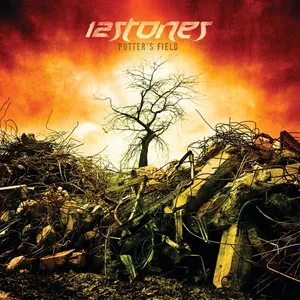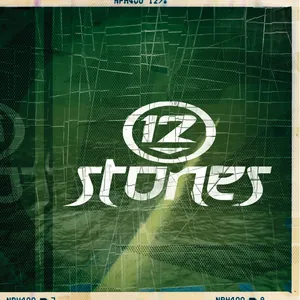
First-time listener beware! Due to the conspicuous verisimilitude on the first track between the music of 12 Stones and Creed, you may be tempted to prematurely label these 70's retro rockers as a cookie-cutter-Creed-knock-off band. 12 Stones are obvious aficionados of the ubiquitous Creed, and significantly influenced by them, but a closer, longer listen will reveal an appreciably distinctive element, one that renders the band a separate entity with a mind, message and will all their own. According to celebrated personality theorist Erik Erikson, "sameness, continuity and social solidarity," like uniqueness and separateness, are essential ingredients in the formation of identity. In addition to the Creed-bleed on various selections, there are also appreciable hints of P.O.D. but 12 Stones are no more peas of the same pod as P.O.D. than they are cut from the same cloth as Creed. Still, they are all brothers in Christ, boldly serving the same king, and basking in the same richness of the same inheritance. So who's going to complain if they share a few chord changes, rockin' riffs and stylistic flavors here and there?
As I lie tossing in my bed
Lost in my fears
Remembering what you said
And I try to hide the truth within
The mask of myself shows its face again
12 Stones' affinity for Creed is never more conspicuous than on the first track, "Crash," a head-on collision between ontological anxiety and God's abiding presence and faithfulness. Though frontman Paul McCoy's mercurial, emotionally intense vocal style is admittedly simulative of that of Creed's Scott Stapp, one gets the sense that McCoy is emotionally connected to the song and not simply acting as a Stapp surrogate. By revealing "the mask," an archetype Carl Jung also referred to as "the persona," McCoy assumes ownership of his own defensive facade, thus rendering it impuissant or powerless, while rendering McCoy and his musical companions emotionally vulnerable. "Crash" is a song that alternatively delivers paroxysms of intense anxiety and impenetrable peace. The successful expression of these complexes of opposites is a fait accompli thanks to a confluence of varying levels of McCoy's vocal intensity, Eric Weaver's weaving guitar pattern, and a tight, frenetic rhythm section that provides an anchor on the undulating waves of self-doubt and insecurity.
"Broken," the album's second track reveals another side of McCoy. This prayerful tune is most accurately described as a primal scream psycho-"prayerapy" jam session. If only the mood of the vocals matched the mood of the overall instrumental arrangement. It is decidedly brighter, and together this creates somewhat of a disjointed, incongruent musical impression. "Daily in my sin I take your life," but most of the band's hate and self-blame appears to be turned inward. "Nothing's gonna change until I'm broken," represents the humble longing of a spirit plagued by guilt and shame to be released. It is a passionate plea for God to "break and enter" into his hardened heart, a sentiment redolent of some of the most memorable poetry of 17th century British poet, John Donne.
The lyrics of "Broken" are stone weapons aimed at the band. Though there are plenty of lines beholding the grace of the savior, the guilt and self-contempt on this penitently introspective journey speaks louder than the grace. When will the self-inflicted punishment end? Jesus once said to a brutal band of Pharisees who wouldn't dare to see, "He who is without sin, cast the first stone." Yet although the band clearly portrays themselves as not only "with sin" but also as the most abject of sinners, they seem quite intent on stoning themselves. By the third song, they've already cast three large stones, and I'm wondering how many more will follow? According to my clumsy calculations, in order to reach 12, nine remaining stones are left to cast. Knowing that it is human nature to punish ourselves despite the knowledge that the price for our sins has been paid, I will not add insult to injury by casting my own stone at the band for their predilection for self-depreciation. Besides, they're darn good at damning themselves. Why stand in harm's way?
Fortunately, by the next song, they are growing weary of castigating themselves: "I hate the way I feel tonight." Paranoia, another seed fallen from the tree of Creed, sprouts with the line, "Spiteful eyes are watching me with everything I do." In Creed's case, to a certain extent, the paranoia is reality-based, not really considered paranoia in the pure, clinical sense of the term. In the case of 12 Stones, the degree to which the putative paranoia approximates true paranoia will remain a stone unturned, at least for the time being.
Progressing through the 12 songs on 12 Stones, the band gradually loosens up, becomes less predictable, and experiments with a few rather innovative guitar licks and vigorously energetic rhythms. Moreover, while falling short of extemporizing, they become increasingly playful with their instruments, not going as far as No Doubt on Rock Steady, but at points coming every bit as close to having a good time as The Strokes do on "Is This It."
While all of this musical experimentation is going on, one cannot help but notice a lucid lyrical leitmotif gently emerging and repeating throughout the entire 12 songs, that of seeking solace from the storms of life in the arms of a much-celebrated-Savior and turning to Him at every curve in the rocky road to rock 'n' roll redemption. 12 Stones approach the throne of grace like a patient would a psychologist's throne. Using music as a vehicle for delivering emotional burdens to a gracious God is a good way to go. God understands the human psyche better than the most educated shrink on earth.
The lyrics on 12 Stones are every bit as emotionally revealing as a 50-minute therapy session. By track ten, one of my 12 most favorite songs on the CD, the band is "Running out of Pain." Though they may still have a long way to grow, there are some things they will never be running out of--raw energy, invigorating verve and a prolific abundance of talent. Add these 12 Stones to your rock collection.
3.5 tocks
Other coverage for this album
Art for the Ears 2002Reviewed by Marco PovervestWhile I write this, the band is on a US tour with label mates Creed. So, who are the 12 Stones? Well, this is a modern rock band consisting of four young guys. With this self-titled product they present a debut that was produced by Jay Baumgardner (who has worked with Papa Roach, Coal Chamber and others). This resulted in a disc that sounds heavier than the average modern rock CD that I've come…The Phantom Tollbooth 2002Reviewed by Brian A. Smith12 Stones is the latest entry into the "heavy melody" category, doing their best to incorporate the sounds of Creed, Disturbed, Linkin Park, Godsmack, Rage Against the Machine, and P.O.D. into their music. Interestingly enough, Wind-Up Records had scheduled them to open for the recently cancelled Creed tour. The approach here parallels Creed almost identically: hard rock music, guitar solos,…The Phantom Tollbooth 2002Reviewed by Bert GanglPerhaps owing to New Orleans' thriving live music scene, the path to widespread exposure for Louisiana's 12 Stones has been a relatively short one. Hailing from Mandeville, a rural town of roughly 8,000 just north of the Crescent City, the band was invited to play for industry representatives in New York after only a dozen or so live shows and netted a major-label deal with Wind-up Records less…Similar sounding releases
 2005The Never EndersAir Raid Romance
 2003SkilletCollide
 2004EarshotTwo
 2004Breaking BenjaminWe Are Not Alone
 2002ChevelleWonder What's Next
 2003DoubledriveBlue in the Face