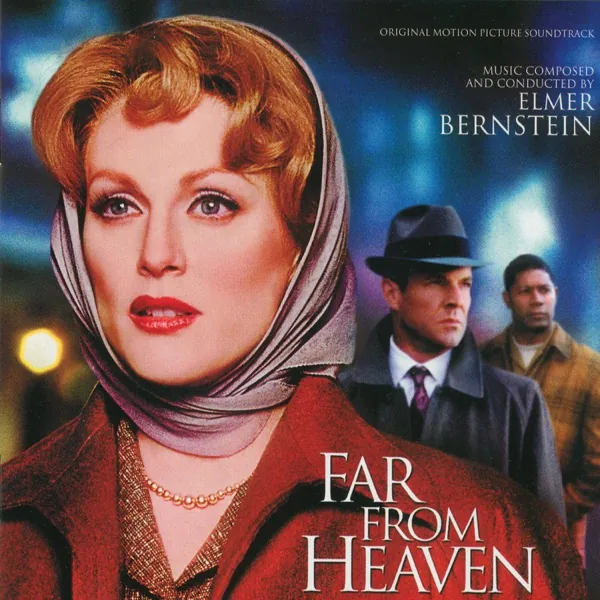
Director Todd Haynes' film, Far From Heaven, is a loving tribute to films of the 1940s and 1950s where a sturdy heroine braved strife with stiff upper lip and few tears. Lana Turner (Imitation of Life), Bette Davis (Now, Voyager), Joan Crawford (Mildred Pierce) and Barbara Stanwyck (All I Desire) would have been proud of Far From Heaven and its soundtrack. Max Steiner was in top form when he won the Oscar for Now Voyager and now, Elmer Bernstein, along with Howard Shore (The Two Towers) and Philip Glass (The Hours) has a good chance for an Oscar nomination.
The story of Far From Heaven concerns the marriage between Julianne Moore and Dennis Quaid. It's in the 1950s, and they have what looks like a perfect marriage--house in the suburb and two children. However, Quaid hides a secret and when it comes out, Julianne is literally dumbstruck. She turns to the black gardener (Dennis Haysbert) for friendship, but this scenario is frowned upon by society at that time and gradually her perfect marriage cracks open at the seams.
Composer Bernstein uses a theme that seems vaguely familiar and the audience wants to hum along with it, as the theme is played often. Bernstein varies the melody to match the situations in the film. The theme ("Autumn") is played at the beginning to introduce the audience to society at that time. It is an idyllic day in the town. We hear it again at the "Party" when the problems between Dennis and Julianne come to the forefront in public. In "Crying," the oboe has the melody, but it is still present. Society's mores are present even in private. "Dance," where Julianne and Haysbert enjoy a dance together, has the melody as part of the lounge music and played by lone saxophone. In "Walk Away", the melody is carried by the piano atop strings. When Quaid goes to Miami, the seductive melody is there with Latin American beat. Finally, at the end ("Beginnings"), the solo piano is the last to be heard with this particular theme, but the main characters have moved on and this society doesn't have the hold on them it once had. In the program notes, Elmer Bernstein says, "The piano is the very first thing and the very last thing one hears in this score. It is an instrument very suitable in the sense that this is a drama which essentially takes place in the house, and one does associate the piano with being an instrument that is in the house."
Bernstein introduces a new theme for Julianne in "Hit," when Quaid slaps her. The new theme, with minor mode, is briefly heard throughout the last selections of the CD. It vanishes in "Beginnings" when the stronger main theme comes forward. The segue between themes is well done. Bernstein has done his homework. When listening to this soundtrack, with its immersion in 1950's theme music, the listener wants to have a watercress sandwich with a cup of tea in a china cup.
3.5 tocks
Similar sounding releases
 2002Nicola PiovaniPinocchio
 2005Symphony in RedSymphony in Red
 1999Joe HisaishiPrincess Mononoke OST
 2002Philip GlassNaqoyqatsi
 2004Terence BlanchardShe Hate Me (soundtrack)
 2004Dolce TriadLast Exile OST, Vol. 2