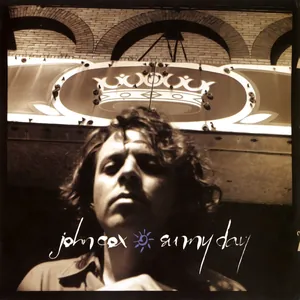
Though 1996 was widely acknowledged as a mostly stinky year for new releases for both secular and Christian music, there were bound to be a few rays of hope at a time when sales and morale were both teetering. And as in 1995, the most intriguing new artists were not to be found on the "major" Christian labels. Enter John Cox. Though a salty music veteran (he was probably in high school while the Tooth & Nail roster was busy being born), Cox is just now breaching the national music scene with his Sunny Day album. This release comes far closer to deserving the "acoustic rock" moniker than most albums advertised under that style, combining heavy acoustic guitar rhythms with a stripped-down band sound for a mostly satisfying result.
Rhythm is key on this album. Acoustic guitar frequently walks in lock-step with the bass and drums, leaving the electric guitar free, as it should be, for occasional flourishes instead of drenching power chords. Producer David Kershenbaum, who won a Grammy for his splendid work on Tracy Chapman's debut album, turns in a less innovative but still well-conceived effort which is most reminiscent of Steve Wiggins' first Sparrow album in the early '90s. Meanwhile, Cox's voice is uncharacteristically strong and wide in range for the modern rock scene, leaving one to wonder if it might have not spent a previous incarnation fronting a metal band. He also has the vocal tics and quirks well known in the wide world of "alternative" music. While none of the tunes grab at the listener instantly for a replay, most are solid, and this is the sort of album that makes for keen listening while driving with the windows down.
Lyrics, too, are a cut above the average. Subjects like "Thank you for saving me, God," and "Buddy, you should become a Christian!" abound in Christian songs, but Cox approaches them from different enough angles to avoid the typical cliches. "Hand I Hold," the album's most contemplative song, is a pleasing approach to Psalm 8's "What is man, that thou art mindful of him?" sentiment. Only on "I Don't Know" does he put his wrong foot forward. When he cries, "Don't ask me how it feels to be unforgiven... I don't know," he surely means it as a declaration of his thanks for salvation, but it comes across more as a proclamation that he has no empathy with non-Christians. Indeed, later on the album he affirms that very empathy, asking Christ, "Were you ever unlovable like me?"
While Wiggins' acoustic rock album flopped in a time when "Christian rock" still meant "metal," Cox may fare better in today's more "alternative" climes. This is an album that grows with repeated listening, despite the absence of any single attention-grabbers. Given the length of Cox's career in music already, he may well have another ten songs like these, even now waiting to be recorded. I hope so.
Other coverage for this album
7ball #9Reviewed by Mike ParkerFor all you closet Zeppelin junkies, the wait is over. With passionate, wailing vocals and hard-edged, gritty guitar leads layered over acoustic-based rock melodies, John Cox's debut project, Sunny Day, feels like a return to Houses of the Holy. But while comparisons to LZ are inevitable, particularly on the title cut, Cox is by no means a Robert Plant clone. Veteran producer David Kershenbaum,…