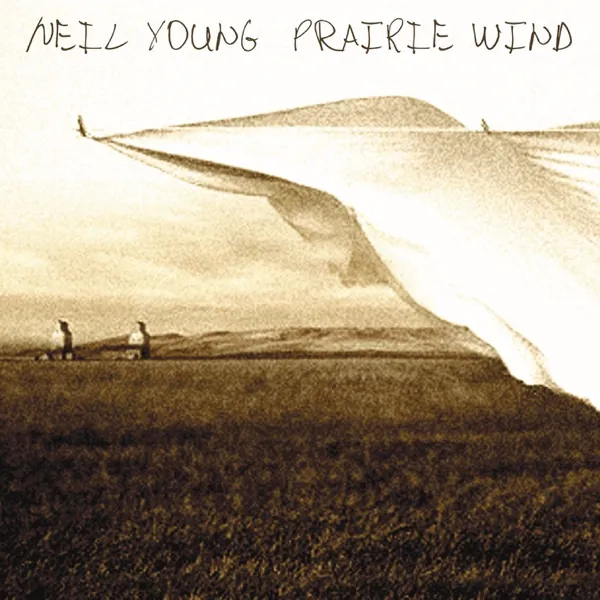
A lot of water has passed under the bridge for Neil Young since 2002, when Neil Young blessed us with Are You Passionate?
Some of the waters that have passed have been choppy, and rough, but the bridge of Young's spirit, has remained strong. Some of the waters have been filled with streams of sadness. Among the most noteworthy of a series of trials Young has had to endure are the passing of his father (just a few days before Fathers Day of this year), and a recent surgery for a brain aneurysm. The fact that Father's Day Song of Sympathy for Neil Young has been so well received is a testimony to the overwhelming love his fans have for him.
Loss is often, sadly, the concomitant byproduct that comes with aging, and with Neil's recent colossal contribution to culture, Prairie Wind, he demonstrates his ability to grow old gracefully, despite the pain that accompanies loss, hardship, and disappointment. Some have drawn comparisons between Prairie Wind and Harvest Moon, but as the titles may suggest, in terms of the lyrical content, and the overall sound, I found Neil to be reaching for the stars in Harvest Moon and to be clinging to the earth in Prairie Wind. There are also parallels between Prairie Wind and its predecessor, Are You Passionate? It is not the case of an elderly citizen repeating the same old stories again and again, but the story of the same universal themes, newly landscaped and revisited from an entirely new perspective by the same beloved artist. It's as if that prairie wind that inspired the album's title and underlying concept has breathed a whole new life into them.
I can relate to the prairie wind fellow Canadian Neil Young pays tribute to in this generous offering because I once felt that same wind blowing on my face as a child, a teen-ager, and finally, as a young man, as I strolled casually through the wheat fields of Saskatchewan. In the wintertime, it was an icy cold that left my face red and caused a chill to ripple down my spine. In the summer it was generally a gentle breeze, and in spring and fall, it was gusty and, often, dusty.
Neil Young follows the wind through all of its seasons on this album, but the gusts are not as fierce as they were in Young's younger days, and the winter wind is a bit more merciful. Overall, it seems like an album dedicated to the autumn. It is perhaps early autumn in Neil Young's life. All of the colors of the leaves are vibrantly depicted in this collection of Young songs.
If that prairie wind had its way with me back in my youth, I'd be a free spirit now, but I didn't trust it enough to follow it. Oh well, as Neil Young said in track one...
...If you follow every dream, you might get lost...
If I had to be lost, however, I would much rather be lost in a prairie wind than in the city skyline. Urban life has robbed us of so much. We have all traded in our birthrights for city lights, and the accompanying stress that comes with living in the industrial age. The prairies of mid-western Canada symbolize a time and a place marked by a certain innocence that is now all but lost in urban civilization.
When I heard Prairie Wind, I had to pinch myself to find out if I was dreaming. I was. I was dreaming of a time and of a place that Neil Young has worked hard to recapture and to preserve in the musical museum that is his mind. The first track on the CD, The Painter, introduces the tracks to follow as one might introduce a collection of long lost friends. The Painter brings out the poet in Young, and what is a poet, if not a painter of prose? The Painter exposes us to a breeze that will build into the prairie wind.
I have my friends
Eternally
We left our tracks in the sound
Some of them are with me now
Some of them can't be found
I wonder if Neil was thinking of former friend and fellow band mate, the recently deceased Bruce Palmer, when he wrote these words. They not only reflect upon the fondness Neil feels towards his true friends, but also upon the enduring value of friendship, and the enduring value of music as a diary for songwriters wanting to contribute a few entries that will fill the void of humanity.
Tryin' to remember what my daddy said
Before too much time took away his head...
Struggling to recapture memories of a loved one, including the words of that loved one, is a way to memorialize the person we love and miss, in long term memory. The more we feel we remember of them, the more we feel that in some way, they remain with us, at least in spirit. I have heard many sentences spoken by those who have lost their fathers that begin with, "You know, my daddy once said..."
The fear of being far from home, of being alienated from his family and from his roots, if not in life, then in death, is what seems to drive the song, Far from Home:
When I was a growing boy
Rockin' on my daddy's knee
Daddy took an old guitar and sang
"Bury me on the lone prairie"
...Bury me out on the prairie
Where the buffalo used to roam
You won't have to shed a tear for me
Cause then I won't be far from home
He wants to go back to the time when he thought his dad would never die, and he wants to reunite with his father in death. So he is torn between the past and the future, and is imprisoned in some sense, in the present. Music is the key that opens his cell door and lifts him above the bars and barbed wire. The prairie wind tells him where to go once he has escaped. He heads straight for the prairies. The prairie is for Neil Young, the intimate landscape for memories of his childhood, memories that he treasures more now than ever.
"This Old Guitar" is redolent of John Denver's old song of the same title, in that it shares a similar sentiment, but Neil's song is marked by an entirely different set of auditory and lyrical fingerprints. Every old guitar tells a different story.
In Prairie Wind, Neil's guitar is the horse and buggy that transports his singular voice across prairie dirt clumps held together with strands of grass and thistles, dust that rises and settles in a matter of seconds, and rocks that remain steadfast come wind, rain, hail, sleet and snow. His voice, alternatively smooth and raspy, intimately warms our hearts and wraps our souls in a past he has never left behind to fade. Yes, in Prairie Wind, Young hugs the past with his passionate grip, but, at the same time, he reaches to the future and reminds us that the present has already passed. Young is getting older, but it's an older he's able to shoulder. If you're looking for the fountain of youth, you'll find it in Young. In short, Prairie Wind is a timeless treasure.
4 tocks
Other coverage for this album
The Phantom Tollbooth 2005Reviewed by Steve StockmanThough Paul McCartney brought in Radiohead producer Nigel Godrich to give some quirk to his new album Chaos and Creation in the Backyard and The Rolling Stones' A Bigger Bang is their best album in twenty years, it is Neil Young who wins the best "over-sixty from the 'sixties" to release an album in early autumn. Young's album Prairie Wind is being likened to his 'seventies classic Harvest and…