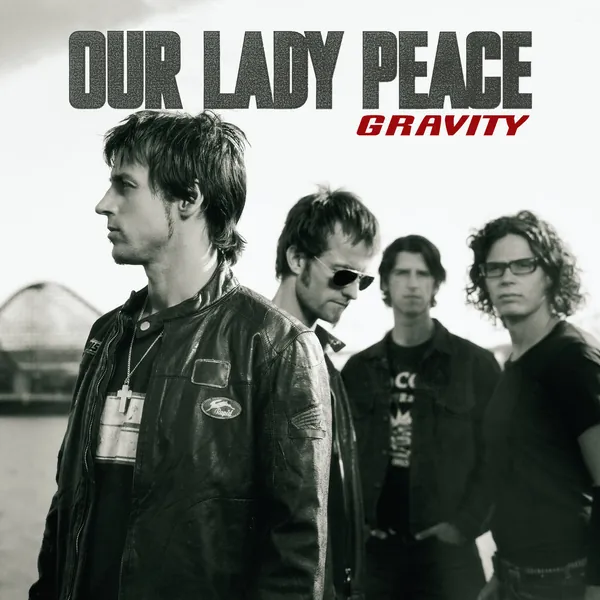
I read a recent interview with Raine Maida, lead singer of Canadian band Our Lady Peace, where the interviewer sprung a surprise question: "What if God was one of us?" I presume the question was prompted by the recurring religious and spiritual themes splashed throughout this band's five album career. Maida hesitated, acknowledged the profundity of the idea, and then dodged the question with an inane comment about his hangover.
Our Lady Peace's latest album, Gravity, is characteristic of that response. Musically as well as lyrically, there is an unequivocal undercurrent of hope and faith that pulses through these songs. At the same time however, one gets the feeling that the band doesn't want to reveal too much about their spirituality, whatever that might be. Maida keeps his faith cards very close to his chest.
Take, for example, the second verse of "Innocent," the near-perfect rock anthem which first drew my attention to this band with its high rotation on radio.
Tina's losing faith in what she knows, hates her music, hates all of her clothes
Thinks of surgery and a new nose, every calorie is a war
While she wishes she was a dancer, and that she'd never heard of cancer
She wishes God would give her some answers and make her feel beautiful
This is probably every teenager's experience at some point, as hormones and peer pressure wreak havoc amidst the youthful search for meaning. Maida clearly relates and offers hope for the troubled young soul, looking for the sun shining through the clouds.
I remember feeling low, I remember losing hope
I remember all the feelings and the day they stopped
We are, we are all innocent
While certainly melancholy in tone, the music is astonishingly positive in its strong intro beat, major chord progressions, and surging chorus. This is certainly no smelly, teen-spirit, downer anthem. But here's the rub. I find myself wishing this song had a third verse. What happened on the day the singer stopped feeling low? Was it simply the realization that "we are all innocent"? Innocent of what? And why doesn't God give Tina answers? Come on Raine, what's really on your mind??
In the end, Maida doesn't let on much at all about his reason for living. He drops mentions of praying and feeling things in his soul, but so does every pop singer. Overall, his lyrics point to the realization of one who knows that there can be freedom beyond the pain, pressure and problems of life, but doesn't say how he finds that freedom.
A common theme on Gravity appears to be the grieving for a friend who committed suicide. "Somewhere Out There," "Made of Steel," "Sell My Soul," and "Not Enough" all seem to address a loved friend who has departed under tragic circumstances. Even so, there is a hope that life goes on beyond death for the one who has passed away:
You're falling out of reach, defying gravity
You're falling back to me, you're a star that I can see
I know you're out there, somewhere out there
("Somewhere Out There")
In the present, the giving of oneself to another in caring love and friendship is also reiterated:
I can be anything that you want me to be
A holy cross, some sympathy, that reminds you how to bleed
They found the note down in your car
You climbed up here to fall apart
They knock you down, I'll pick you up
They laugh at you, I'll shut them up.
("Made of Steel")
Interestingly, the band's debut album Naveed was produced by Arnold Lanni, the same guy who produced the tragically underappreciated King's X album, Ear Candy. Four albums later, Bob Rock (of Metallica's black album fame) is at the helm, but the band achieves a sound that hints at the characteristic low-end crunch of King's X while attaining the accessibility that seems to be Rock's forte. While staying decidedly at home in the mainstream pop/rock genre, they get a progressive, tempo-changing groove going on with several tracks including the cataclysmic, haunting opener "All for You" and "Sorry," which in itself raises the questions again about Maida's spiritual motivations.
Today's a reason for living. Today's the blood from a stone
Today's the light from a candle, helping us find our way home
Today we carry each other. Today the past is a freak
Today is the time for forgiveness. You were never that good to me
Today's the crosses we carry. Today's the strength that we need
Today's the hand of an angel. You were not the kind to believe
Today is the time for forgiving. Today I wish I could
("Sorry")
While I remain curious about his faith journey, it is clear that Maida has found a peace in his heart which inspires him to write such uplifting songs that don't just wallow in pain, but offer hope for another day. To translate that hope into the very fabric of a song's musical construction is a rare talent indeed. Our Lady Peace is a massive grunt of rock affirmation that should be enjoyed to the full.
4 tocks
Similar sounding releases
 2004Breaking BenjaminWe Are Not Alone
 2004BlindsideAbout A Burning Fire
 2002KutlessKutless
 2003The Juliana TheoryLove
 2003SkilletCollide
 2003Lucerin BlueTales of the Knife