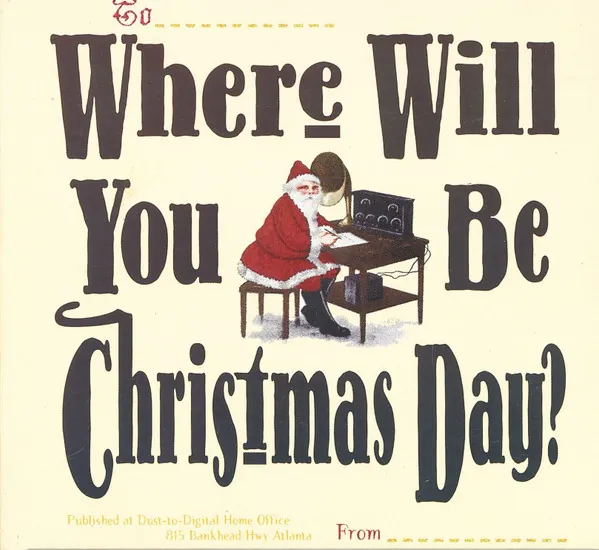
Lance Ledbetter's ear for putting together a revelatory compilation hasn't failed yet. As if to celebrate Dust-To-Digital's Grammy nomination for its astounding first release, the sextuple CD Goodbye, Babylon box set chronicling American gospel music history, Ledbetter's fledgling label releases the even broader ranging Where Will You Be Christmas Day?.
Within 24 tracks recorded from 1917-1959, sacred and secular perspectives on the titular holiday from deep within the American melting pot. It's a musical journey broad enough to accommodate the hearty caroling of The Alabama Sacred Harp Singers' Anglo-Celtic "Sherburne" on one end and Butterbeans and Susie's wry rhythm & blues "Papa Ain't No Santa Claus (And Mama Ain't No Christmas Tree)."
If those acts fall to more obscure crannies of history, some genuine genre stars make the cut as well. Classic '20s blues comes courtesy of the provocative Bessie Smith's "At The Christmas Ball"; supply the other entendre yourself. Early electric blues gets a nod from Lightnin' Hopkins' killer "New Years Eve." Lead Belly's fulsome folkiness bears upon the holiday in question on the short "Christmas Is A-Coming," and Maddox Brothers and Rose take "Jingle Bells" to rousing old-timey country.
Just as on Babylon, detours are taken to the Trinidadian sounds of early calypso. The sacred-to-secular gamut runs from Lord Executor's "Christmas Is A Joyful Day" to Lord Beginner's "Christmas Morning The Rum Had Me Yawning," but both are fun examples of one of the earliest ethnically exotic musics introduced to the U.S. record-buying public.
Other contingencies of foreigners recorded Christmas tunes, all in New York City, during the first half of the previous century as well, among them Puerto Ricans (Los Jibaros' guitar-led "Decimas de Nacimento"), Italians (Pasquale Feis's "Tu Scendi Dalle Stelle") and Ukranians (Pawlo Humeniuk's "Dance Under The Willows," an instrumental featuring sleigh bells). If all that's too headspinning international, catch Rev. J.M. Gates' fiery sermonette "He Was Born In A Manger." Before radio brought church to home listeners, such recorded preaching by Afrimerican pastors sold plenty of 78 r.p.m. shellac.
The grandiose packaging of Babylon would have been impractical for a single disc such as this, but more detailed liner notes would have been a useful addition to the nifty gatefold cardboard sleeve. The little booklet included offers a small bibliography for those wanting to learn more about the sounds here. Even without further reading, Where is a treat for armchair ethnomusicology and anyone wanting a wildly diverse holiday earful.