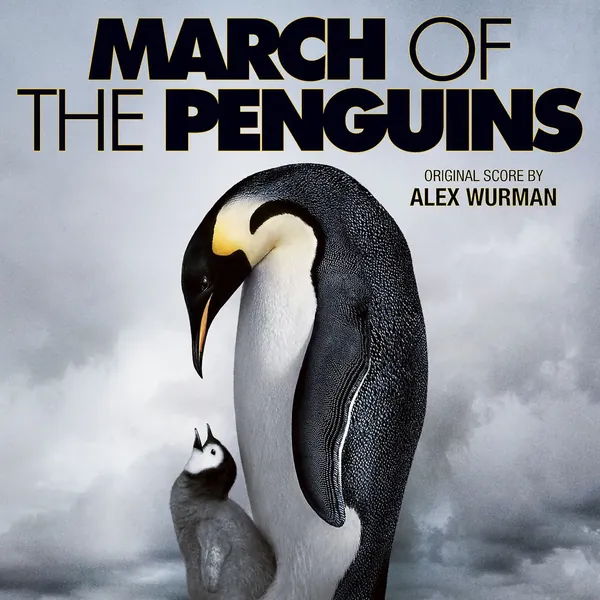
March of the Penguins is the surprise documentary hit of 2005. Not only does the film contain spectacular photography of south-of-the-Equator Antarctica (especially enjoyable when viewed during hot summer months), but details the life of the Emperor penguin. This particular bird, arrayed in black, white and a touch of orange, chose to live in the nether regions when weather patterns changed thousands of years ago. Adapt or die and the penguins adapted with an unusual life style that combines travel, economy of body function and the perpetuation of the species. The film is rated G for general audiences.
This reviewer is going to go out on a limb and predict that Alex Wurman's soundtrack for March of the Penguins will be noticed by the Academy at Oscar nomination time and possibly garner an Oscar. The music co-exists with what is appearing on the screen. Even if the narration were deleted from the film, the audience could see---and feel---what was happening in the lives of the Emperor penguin with parenting skills city-dwellers would envy at the far side of the world.
How does one produce 70 minutes of music in six weeks? Alex Wurman is considered a fast composer and did just that. The March of the Penguins that U.S. audiences see is basically the same visual footage that was shown in France, but the soundtrack and narration was changed. Actor Morgan Freeman is heard in the U.S. version and Alex Wurman has provided new music that accompanies the film visually while capturing the mood of that particular moment. Titles of the various selections follow the movie's structure mood from "The Harshest Place on Earth" to "Found Love," "The Egg Arrives," and the ever-present, "The Dangers Remain."
The first selection on March of the Penguins sets the tone for the film. "The Harshest Place On Earth" gives an aural concept of beauty and danger with the melody alternating between major and minor keys. Life is present but always in a precarious location. "The March" has solo flute, bassoon and piano, accented by percussion. Alex Wurman has pointed out that "...this cue and others use 3/4 and 6/8 simultaneously." He was able to utilize a full string section in Los Angeles and the orchestration shows creatures on the move and the urgency of that moment.
"Found Love" has a falling raindrop effect stylized by flute. Life is perpetuating and the choral resolution at the end will continue into "The Egg Arrives," which also has the raindrop-effect. Major and minor are side by side in 3/4 time as life and death co-exist in this harsh world.
"Arrival at the Sea" is when the female penguins finish their 70-mile march for food. The musical impression of water is defined by flute, piano and harp. The piano has, what I call, a scampering pattern, which is the rush for water and the fish it contains. Once again, major/minor are together in life and death and the dangers of the sea. "Walk Through Darkness" is the return trip of the penguins as the season has changed. It is now winter south of the Equator and days are short. Lone flute shows the road seems longer and some penguins may not make it. This is solitude, as you have never seen it before.
"First Steps" appeals to children and they can recognize playfulness in the music that ends like a dance finale. The penguin chicks are emerging from their parent's protection, but "The Dangers Remain" concerns an enemy that flies at inopportune moments. "Reunited" (and one of my personal favorites) has a hymn-like, chordal feel with flowing and precise piano. This is a definitive piece in that with all that goes on in the penguins' lives, there comes a perfect moment in life---the family together.
The soundtrack ends with "Going Home for the First Time" as flutes glide atop percussion. There is an underlying sadness of cello telling the listener that this will end soon, but for this moment in time, the 3/4 tempo in major/minor echoes the loneliness and beauty of life in Antarctica.
Alex Wurman wrote all the melodic passages for the March of the Penguins soundtrack, there was no improvisation. Wurman says he, himself, is an improviser and has a style of playing that allows him to improvise so he sculpts his writing into a spontaneous feel but has a motivic tie into the rest of the music. Wurman has created relationships with quality musicians and is fortunate to be able to record in his own studio. Alex is a morning person who composes at the computer.
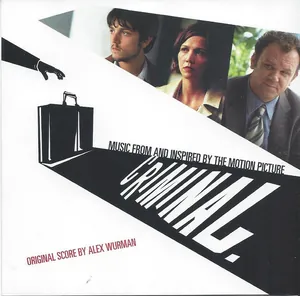
To say that Alex Wurman comes from a musical family is putting it mildly. His father, Hans Wurman is a noted arranger and composer who frontiered works on the Moog synthesizer. Alex Wurman studied music at the American Conservatory of Music in Chicago and then moved to Los Angeles. He has worked for a period with Hans Zimmer. This reviewer first noticed Alex Wurman's name for the soundtrack of the 1999 film, Play It to the Bone, with Antonio Banderas and Woody Harrelson. Since then, there have been, among other films, credits on Confessions of a Dangerous Mind, Anchorman: The Legend of Ron Burgundy, Thirteen Conversations About One Thing, Criminal and now, March of the Penguins. Alex Wurman's next project is the comedy about NASCAR, High Wide and Handsome starring Will Ferrell and John C. Reilly.
Wurman is beginning to be approached by people to write soundtracks for them, but the process has taken 15 years. His words for the musician who wants to get into the business of writing soundtracks, "...composing is something you really have to invest yourself in and study the greats so you can learn how to create an emotion....some musicians may be at the stage where they are technically able to pull the job off but not necessarily at the stage where they are compositionally prepared...hoping that people approach the job with enough love and respect so we get things that have substance." Alex got it right.
March of the Penguins won the 2005 Academy Award for Best Documentary Film.
4 tocks
Similar sounding releases
 2004Kô ÔtaniHaibane Renmei OST
 2004Max RichterThe Blue Notebooks
 2004Terence BlanchardShe Hate Me (soundtrack)
 1999MusFai
 2001Hilmar Orn Hilmarsson / Sigur RósAngels of the Universe
 1999Joe HisaishiPrincess Mononoke OST