Take a look at the tracklist of this instrumental, sort of abstract album with my commentary:
1. Your Breath in Mine - (an interpersonal situation)
2. Rosslyn - (a lady's name)
3. Moonless - (nighttime)
4. Vermillion - (a bright, strong, orange-red color used by painters for blush tone)
5. Dulles Corridor - (an airport place in Washington, D.C., the artists' locale)
6. Mezza - (middle)
7. Burgundy - (another ruddy color)
8. Aria - (another female name, and a blue-ish movie)
9. Incandescent - (white hot glowing)
10. The Birds - (romance is for the birds)
Night Is Invisible, "1," is the collaboration from 2000 to 2004 of Chaz Barber and Nathan Burke in Springfield, Virginia. Chaz Barber as the bulk of the artist entity Brahm has done beaty, jazzy, somewhat noisy electronic work with keyboards, samples, interesting instrumental stuff - sometimes having brought in his poetry and rapping on debut "A Thousand Curves," or Nathan and wife Rachel Burke's vocals on recent "Built to Be Brought Down." Nathan Burke, judging by his later Frodus work, ". . . And We Washed Our Weapons in the Sea" and his debut with The Out_Circuit, "Burn Your Scripts, Boys," seems to be a major contributor of grooves, atmosphere, and dynamism - often tense quiet with breathy vocals with cool bass lines, and then rather intense loudness with distorted screams and pounding who knows what. Chaz Barber became good friends with Frodus toward the end of their active career as that entity and contributed much to The Out_Circuit album. Chaz Barber and Nathan Burke seem a good pairing.
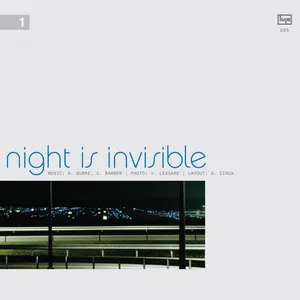
Former Frodus member Shelby Cinca did a clean job on the visual design on "1" with a single panel insert, using cool blues and grays with cropped instances of a nighttime cityscape shot by V. Lessard. The photo, along with the rest of the design and some of the musical stylings and colorings, are deceptively sleek and non-organic; a closer look to my surprise reveals grass on a gentle hill in the fore and middle grounds leading up to asphalt and highway railings below black empty space with scattered city lights with perhaps some airport runway lights. Two light poles rise from the grass in the foreground above the picture's top, with a third vertical element, perhaps a section of a train window frame where the photographer sat. The abstract city night imagery seems appropriate to the music. Inside the tray, the photo is cut up almost like a barcode, and is simplified and broken down such that, on the left, the pixels become rectangles about a centimeter tall. This is night music and this is travel music. If you asked Chaz Barber, he would call it sex music. He and Nathan Burke each have done a number of songs about union.
One thing about both Nathan Burke and Chaz Barber - their work tends heavily toward repetition - a repetition that I think is mostly on purpose and sometimes works quite well in their favor. Repetitiveness often carries negative connotations, but it is an aspect of sight and sound that can make things pretty and interesting - and not just when used in moderation. I've witnessed it taken to extremes with fascinating, beautiful results, such as by William Basinski in "The Disintegration Loops." Night Is Invisible does not go that far by any means, but they do use repetition fairly heavily and interestingly, such as conjuring the ongoing drone and rhythm of a commute - in which, presently, something changes, and the new place is more striking and satisfying than if something had changed earlier. Pretty soon, I come to enjoy the at-first boring ride between the fun sounds. Some people, it seems, just cannot vibe that, but I do.
Taking this tangent further, a friend pointed out that repetitive music evokes ritualistic, often nighttime activities, which, I happen to know, is what this instrumental album is about. The first track, "Your Breath in Mine," contains a sample of a woman's whisper, "Be quiet, big boys don't cry," the only time human vocals or speech appear on the album.
I picture this body of work much closer to a Brahm album than one by The Out_Circuit, just because of the form, rhythm, instrumentation and sampling, and the jazz and tribal feelings of it - but if Brahm gets jazzy, then this gets smooth jazzy, with grooves and those "bong" sounding keyboards (not purposely a drug reference) that show up in cool, classy, 80s/90s elevator music. There are very few abrasive sounds other than some of the altered drum beats, nor even distorted guitar, but there remains a lovely sense of mystery at points - both Nathan Burke and Chaz Barber show a healthy affection for the beauty and interest of sound, atmosphere, and subtle dynamics. Muffled, heavily affected drums will presently come out from the other room, clean, sounding like a live cool jazz drummer; equally gorgeous things will happen with short, repeated melody lines, switching from bass lines and keyboard work to horns and strings and various interesting instruments.
"Moonless" has this deep-pitched, wavering sort of hum in the background that could as easily be an African or Aborigine body-length horn as it could be a looped and bent cello note or an affected low synthesizer key held indefinitely. I think of that humming, buzzing rope instrument that Crocodile Dundee swung around and around above his head one twilight atop a hill.
"Dulles Corridor" - Dulles is an airport referenced in Brahm's song "Hourglass Absence" about a fling the rapper/speaker hoped "wouldn't be just a one night stand," and Dulles may well be the airfield I interpret in Lessard's photograph - seems a short, rainy interlude before "Mezza," or middle, and the rest of the album. "Burgundy" continues the newfound water theme with a constant trickling and dripping behind muffled keys, pianos, popping pitter-patters that become soft tapping and brushed drums, intermittent inhaled breath motifs, and then a plugged, unaffected bass line in front of an underwater organ. At the end, everything cuts out and the brush hits the cymbal and high hat for several moments as the water continues to trickle - and for a moment I forget that I hear sticks on metal rather than water hitting ground and window panes.
"Aria," incidentally, is also the name of a fairly blue movie (so I heard). Actually, both Brahm and Night Is Invisible seem like they would fit well as that instrumental music on a movie soundtrack that people think is cool but would consider weird outside the movie context. My high school-aged cousin, for whom I played this album on the way to see "Star Wars," said this sounded like the soundtrack to "Fight Club," which I have not yet quite seen.
"Incandescent" to me feels like a beautiful, contemplative, atmospheric closing to the album, full of droning, echoing keyboard and smooth transitions of chords but with quick, somewhat lively drumming. The album actually completes with "The Birds" (I immediately thought of the movie), slower and even more obscure drones of keyboard, with very up front various effects on a sloshing stepping against water from the shore of a stream (or a bird diving in or flapping out from the surface of a lake) - which is beautiful and surprisingly fitting, as the effect enters abruptly and sounds a bit humorously synthesizer-ish. It ends with a flowing, fading loop of the sampled splash - a nice ending to a solid body of work.
Personally, I have not listened to this album much for my own sake without the review in the back of my mind. Perhaps I think the album is slightly monotonous, plus I dread work of writing about it, and I just am super-much into LN and other super quiet, slow folk/weird shoegaze-ish music the past few weeks, although I still think well of the album.
2.5/4
Other coverage for this album
The Phantom Tollbooth 2005Reviewed by Zach DelphOffering up one heck of a mood-altering album, Night Is Invisible's 1 is a sonic landscape of lush, electronic instrumentation. Featuring Nathan Burke of the late great Frodus, NII takes influence off some of the ambiance that Frodus once created, especially in their later days. This influence can also be seen in Burke's other project, The Out-Circuit. The soundtrack-like album is almost…