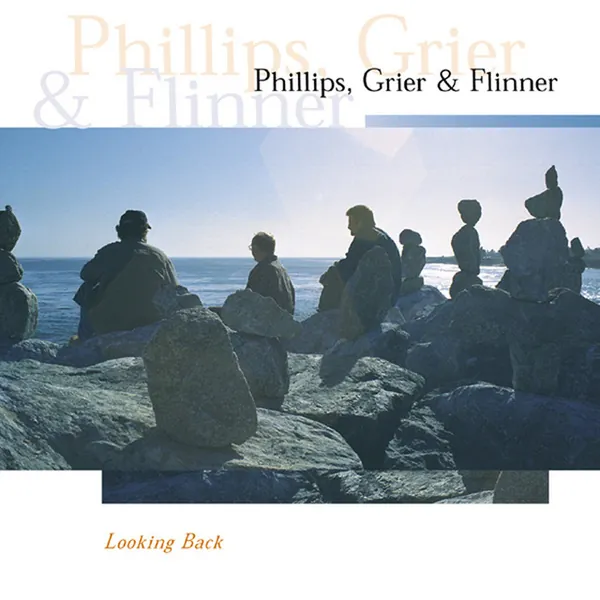
While listening to this album, it hit me that this isn't a typical bluegrass album. True, it is a trio of bass, acoustic guitar, and mandolin, well within the usual range of the genre. Yet, this album seems to owe as much to rock music as it does the bluegrass genre, both in song selection and in overall song stylings.
A case in point is the opening track, "Tennessee Blues," written by bluegrass legend Bill Monroe. While clearly a bluegrass tune, there are hints of rock music in the soloing, as the guitar and mandolin licks go beyond the idioms of even blues soloing. The next track is a fairly straight bluegrass reading of another Monroe tune, "Monroe's Hornpipe." However, with "I Am A Pilgrim," the album takes a turn in a distinctly non-bluegrass direction, sounding more acoustic blues or jazz than bluegrass.
This pattern of taking directions not traditionally associated with bluegrass holds to form throughout the disc. The overall effect is more akin to a jazzy jam session, as on "Afro Blue" than a bluegrass hoedown, although "Dixie Hoedown" is a good example of the latter.
A cover of "Search For Peace" works well in the setting prepared by the first four tracks, and is followed by two bluegrass traditionals-- the aforementioned "Dixie Hoedown" and "Old Dangerfield" before embarking on the last set, perhaps the best part of the album.
What struck me most about this album was that the last two listed tracks, "Little Wing" by Jimi Hendrix, and "I Want You (She's So Heavy)" from the Beatles' Abbey Road album worked so well. I certainly didn't expect an acoustic trio to be able to pull off either of these electric songs with any real conviction or power. Yet, "Little Wing" is very convincingly done, and it can be argued that the cover is as strong as the original in the case of "I Want You." The bass plays the bass line, the mandolin and guitar alternate with taking lead lines, and support each other to fill in the gaps; other than there being no drumming, the effect is very similar to the original song.
If this is the future of bluegrass-- less emphasis on the twang of the vocals, more on the virtuosity of the players, then bluegrass has a bright future indeed. Anyone who appreciates good musicianship owes it to him- or herself to try to track this album down. Looking Back has never sounded so progressive.
4 tocks
Other coverage for this album
The Phantom Tollbooth 2002Reviewed by Jeff EdwardsTodd Phillips (upright bass), David Grier (guitar) and Matt Flinner (mandolin) are not names that will immediately spark interest outside of the immediate bluegrass-fan arena. This is extremely unfortunate. Heads begin to turn when citing the credentials of the individuals - Grammy awards, national championships and magazine awards in particular. Each of the trio is considered one of the best in…Similar sounding releases
 2002Sandy WeltmanThe Klezmer Nuthouse
 2005Drew EmmittAcross the Bridge
 2002Mike Marshall / Darol AngerThe Duo Live At Home And On The Range
 2003Earl Scruggs / Doc Watson / Ricky SkaggsThe Three Pickers
 2005Nickel CreekWhy Should the Fire Die?
 2005Tim O'BrienFiddler's Green