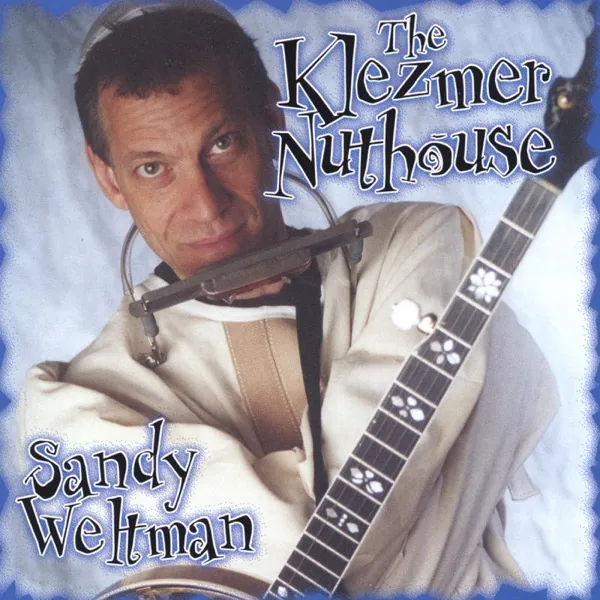
For first-time listeners, Klezmer music may sound like polka music with Middle Eastern flavor. Klezmer means instruments used in songmaking, and from about 1400 or so has come to mean the music by a Jewish musician. The usual instruments used are accordion, clarinet, drums, and perhaps a violin. There is a talented group of musicians gathered for this CD. Besides Sandy Weltman on banjo and harmonica, standouts are Janice Rieman on cello, Michelle De Fabio on violin, Carl Casperson on bass, Carolbeth True on piano, Gary Hunt on guitar, Thayne Bradford on mandolin, and Brian McCary on percussion. What Sandy Weltman and friends have done is to take the Middle Eastern, minor mode of Klezmer music and apply it to Dixieland jazz and bluegrass. The resulting sound is highly listenable, unique, and unusual, hence the title of the CD, The Klezmer Nuthouse.
"Baym Rebins Sude" ("At The Rabbi's Table") is a poignant selection and one of the few with a slower beat. It features a wonderful violin and banjo duet plus an insightful harmonica and keyboard duet. The tongue-in-cheek "Dancing Sheik To Sheik" contains a variety of percussion instruments with excellent harmonica work by Weltman. The title piece, "The Klezmer Nuthouse," has a melody that goes in all directions, conga drums, bass, and rainsticks. What a finger-snapping beat!
"Kaddish" is slower and more mournful, featuring a banjo and cello duet and Beth Tuttle vocals in Hebrew and English. Abe Schwartz's "Varshavers Freylekhs" is a jazz piece with various instruments that specifically highlights piano and bass. Then, it is on to bluegrass with another Schwartz composition, "Kishiniever Bulgar" ("Breakdown"), that has a great ending. "If My People," with Weltman on banjo and Fred Lang vocals, is eloquent with lyrics like "If my people who are called by my name." The CD ends with the rousing "Odessa Bulgar," featuring more excellent harmonica work by Weltman.
There are two selections that did not gel for me. One was "Mazel," in which the instruments did not blend well with a harmonica that was too loud for the group. The other difficulty happened on the medley "Ukrainian Etude," which began with good instrument blend and ended up with loud harmonica.
The Klezmer Nuthouse will introduce you to a new style of music if you haven't heard of it before or continue your interest if you are already a fan. Sandy Weltman and his group have combined traditional Jewish music with jazz flavors to offer a unique blend of musicianship.
3 tocks
Other coverage for this album
The Phantom Tollbooth 2003Reviewed by Ben CauldwersePop quiz: What do the harmonica, banjo, and Jewish Gypsy music have in common? Normally, you'd be right if you answered, "Nothing." The rich sounds of the traditional Eastern European Jewish music known as Klezmer are full of instruments such as the cello, violin, bass, dobro, riq, dumbek, and mandolin. Banjos and harmonicas belong a world apart, in the realm of bluegrass. Yet,…Similar sounding releases
 2003Earl Scruggs / Doc Watson / Ricky SkaggsThe Three Pickers
 2005Old School Freight TrainPickin' on Ben Harper: Speak Out
 2004Sharon ShannonLibertango
 2005Tim O'BrienFiddler's Green
 2003Paddy Keenan / Tommy O'SullivanThe Long Grazing Acre
 2002Nickel CreekThis Side