Radiohead's Sonic Storm of Sound and Fury
In the year 2000, one might expect to hear music that fuses all the strengths of the last decade into timeless, landmark music. You'll find such solid, traditional, yet bold songwriting on the new U2 album, or in the timeless echoes of Emmylou Harris's Red Dirt Girl, in the wise sentiments of Paul Simon as he gets older, or the surprising optimism and playfulness of Sting on Brand New Day. But you might also expect to hear something new, something experimental, that harnesses new tools, new ideas, and breaks the mold.
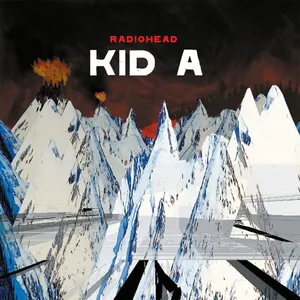
Radiohead, who started cracking the alternative-rock, concept-album mold with 1997's OK Computer, just smashed that mold to tiny bits. Kid A is here. And whether you like it or not, it's not like anything we've heard before. But it's a prophetic of what we'll be hearing on rock radio in the future. Like good art-rock, it requires your full attention and repeated listenings.
Undoubtedly there will be detractors. Whenever an experimental album comes out, critics split right down the middle. Remember the backlash when U2 did Achtung Baby and Zooropa? While half of the fans mourned the loss of an organic rock sound, others heard the potential and the meaning in the continental shift, and now rock radio is cluttered with lookalikes, just as U2 reminds us that they're still capable of traditional songwriting. Now it's Radiohead giving us a window on tomorrow.
Radiohead is the band in the spotlight, where U2 were when The Joshua Tree hit, or where "R.E.M." was when they produced Out of Time. It's their turn now.
Kid A is, in a way, the place that Radiohead has been, um, "headed" all along. On The Bends they introduced us to an electrifying new voice in arena-rock-and-roll. Their cryptic, bleak lyrics prophesied the coming darkness when life is dominated by artificial intelligence, where the world is green with plastic trees, and where the arrogance and heartlessness of bureaucracy has dehumanized our existence. On 1997's monumental follow-up, OK Computer, they challenged us with a cohesive concept album, somewhat like what Pink Floyd might have done in their place. It has become perhaps the most groundbreaking rock record since U2's The Joshua Tree. Dwelling on similar themes, OK Computer told stories of people kept apart by their own technological inventions, desperate, disillusioned, drowning in their own self-taught lies. Packaged in elaborate, brilliant sci-fi soundscapes, the experience was more like a viewing of Blade Runner than listening to eleven songs.
Kid A abandons the familiar, comfortable structures of verse/chorus/guitar-solo rock, and introduces us to free-flowing rivers of electronic instrumentals with voices that sound like they're choking on wires, with verses that get clipped, run backwards, their words jumbled, and then re-played every which way.
"Everything in its Right Place," the arresting opener, introduces three distinct, seemingly unrelated lyrics that twist and writhe on a bed of ominous keyboards. "Yesterday I woke up sucking a lemon," lead singer Thom Yorke mumbles. Perhaps he is referring to a hangover brought on by the indulgence of youth culture or by the technological revolution. On the other hand, it might be an acknowledgement, that Yorke was inspired by the "lemon" in U2's Zooropa... who knows? (U2's The Edge asserts, in recent interviews, that Kid A has captivated him as the band prepares for their next tour.)
The title track sounds like someone thinking quietly to himself, but the thoughts are a weak, indecipherable electronic signal. A few lines emerge from the garble, such as "We've got heads on sticks/they've got ventriloquism." A political statement? It sounds important, but we have to strain to hear it, and most of it is unintelligible altogether.
Next, "The National Anthem" climbs a ladder of noise until we're treated to a long cataclysm of sound that resembles three traveling circuses colliding on train tracks, or, as another publication put it, "a brass band marching into a brick wall."
Only on the fourth track, "How to Disappear Completely" do we finally hear guitar chord progressions and the familiar, desperate crooning of lead singer Thom Yorke. And it's not until track six, "Optimistic," that there's a song formulaic enough to be a single.
Kid A is a masterpiece of innovation, creativity, and sound mixing. It's important because, unlike most pop and rock which is accessible to the masses, it communicates through sound rather than words. What signals we are given point us to the fact that our own technological tools are preventing us from understanding each other. Power is a means of survival, but in using it we trample our own goodness and destroy our own world.
In "Optimistic" (which, by the way, isn't), Yorke sings, "You can try the best you can/the best you can is good enough," but then asserts that our efforts amount only to that of "dinosaurs roaming the earth." We may have become the "fittest", but our survival is still a shaky proposition. Later, in the relentlessly harsh techno-dance beat of "Idioteque", he practically shouts, "Ice age comin'! Ice age comin'! Women and children first!" The "ice age" is, to all appearances, a flood of information and technology. At times, the sounds begin to warp and sway together, as though they are merely rainbow-colored oil slicks undulating on a stormy sea as the singer drowns, his voice farther and farther below the surface... or perhaps WE are drowning, and he is above, somewhere, calling for us.
What amazes me about Radiohead's achievement here is that this music, after repeated listens, only becomes more and more intriguing, and at times downright beautiful. Meaning lurks like the shadow of a monster below the surface; you catch glimpses, but it eludes clear definition. Somehow they've managed to form something profound, artful, and exciting out of the very tools that they warn will be our undoing.
What bothers me is the same thing that has always bothered me about them. They have a very clear picture of the disease. They have a notion that the cure will be difficult to discover, and it won't be found in acts of power or technology. But they have nothing to offer us as hope, as a glimmer of grace in the chaos. They obviously know beauty, because they can powerfully mourn its passing. Perhaps if their future efforts take the time to acknowledge beauty, they might find signs of the answer, signposts toward the One whose designs for humankind have been so sorely left behind.
4.5 tocks
Other coverage for this album
ReAL Magazine 2000Reviewed by David O.Modern music is suffering these days. Living in this hip, technological age is hindering the quality of music currently being made. Instead of writing letters, we write emails, and we don't try as hard as we should to articulate what we're trying to communicate. Modern rock has been greatly affected by the fast paced, convenient world in which it exists. Listen to the radio for ten minutes and…Bandoppler 2000Reviewed by Sarah Jones"[Kid A] is dedicated to the first human clone. I bet it has already happened." -Thom Yorke October 3rd marked the North American release of what is inarguably one of the most anticipated albums of the last three years, Radiohead's fourth album, Kid A. Kid A makes an almost antithetical departure from the clever guitar-driven rock that characterized the Radiohead of the early to mid 90's as seen…The Phantom Tollbooth 2000Reviewed by Michial FarmerKid A, the much anticipated new Radiohead record, is either going to be remembered as the album that changed rock music forever, or as a pretentious, overhyped goat of a record on which the band destroyed themselves. Either way, I think, the band will accomplish its goal. Radiohead has never been known for just accepting pop culture norms (look at the way "1984" collided with "Zooropa" on 1997's…The Phantom Tollbooth 2000Reviewed by Steve StockmanRadiohead have without doubt released the most talked about album in many a long year. Everyone has an opinion and it is mostly that everybody is confused. On first listen, most people say "crap" apart from those who have decided that they are going to say the emperor's clothes are lovely, to be trendy and cool. It is on the second and third listen that the confusion kicks in. A few listens in…Opus 2000Reviewed by Pearson GreerRadiohead certainly doesn't need people like me to suddenly start deciding that it's OK to like them. No, there's nary a shortage of people who will always use their lyrics as signature files on their email, and no shortage of people who will run to The Bends or OK Computer when they get dumped, none whatsoever. Read those people's reviews if you want either a longtime fan's impassioned joy at…Similar sounding releases
 1999Sigur RósÁgætis Byrjun
 2004Bark PsychosisCodename: Dustsucker
 2000K.C. AccidentalAnthems for the Could've Bin Pills
 2003NamelessnumberheadmanYour Voice Repeating
 2001Au Revoir BorealisTienken
 2002Michael Roe / Mark HarmonOrbis
More from Radiohead
 1994My Iron Lung
 1998Airbag/How Am I Driving?
 2001Amnesiac
 1997OK Computer
 2001I Might Be Wrong: Live Recordings
 2003Hail to the Thief